|
|
|
Moxa IA260-LX - RISC-based Embedded Computer with VGA, 4 Serial Ports, Dual LANs, DIO, CompactFlash, USB, Linux 2.6
by MOXA
|
|
|
|
- Cirrus Logic EP9315 ARM9 CPU, 200 MHz
- 128 MB RAM on-board, 32 MB flash disk
- 4 software-selectable RS-232/422/485 serial ports
- VGA interface for field site monitoring
- Dual 10/100 Mbps Ethernet for network redundancy
- 8+8 DI/DO channels, up to 30 VDC
- 12 to 48 VDC power input design
- Supports CompactFlash and USB 2.0 hosts
Ready-to-run Linux/WinCE 6.0 platform
-40 to 75°C wide temperature models available
|
|
|
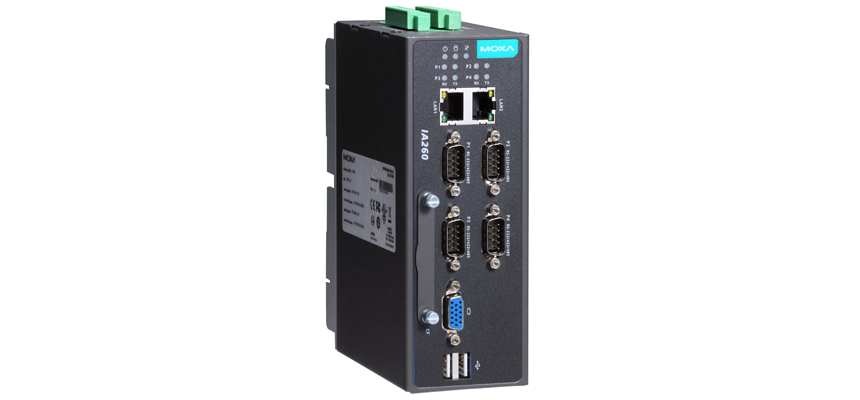
The IA260 embedded computer comes with 4 RS-232/422/485 serial ports, dual Ethernet ports, 8 digital input channels, 8 digital output channels, VGA output, 2 USB hosts, and a CompactFlash socket. The computers are housed in a compact, industrial-strength aluminum case.
The IA260 computer uses the Cirrus Logic EP9315 ARM9, 32-bit, 200 MHz RISC CPU. This powerful computing engine supports several useful communication functions, but will not generate too much heat. The built-in 32 MB NOR Flash ROM and 128 MB SDRAM give you enough memory to run your application software directly on the IA260.
With its built-in VGA output interface, the IA260 is suitable for use with SCADA systems in industrial applications, such as factory automation, production line process monitoring, and mining automation, that require VGA and HMI features.
The IA260 computer supports RS-232/422/485, digital I/O, and has dual LAN ports, making them ideal as communication platforms for industrial applications that require network redundancy. In addition to the standard model, wide temperature (-40 to 75°C) model is available for use in harsh industrial automation environments.
The IA260 embedded computers come pre-installed with either the open standard Linux OS, or the more common WinCE OS. Software written for a desktop PC can be easily ported to the IA260 platform by using a common compiler, without needing to modify the code, and the software you develop for your own applications can be stored in the IA260’s flash memory
| Hardware Specifications |
| • Computer |
| CPU |
Cirrus EP9315 ARM9 CPU, 200 MHz |
| OS (pre-installed) |
Windows CE 6.0 or Linux |
| DRAM |
128 MB onboard |
| Flash |
32 MB onboard |
| USB |
USB 2.0 compliant hosts x 2, type A connector |
| • Storage |
| Storage Expansion |
CompactFlash slot |
| • Display |
| Graphics Controller |
EP9315 internal graphics accelerator engine with TTL graphical signal support |
| Display Memory |
Dynamic video memory (shares system memory) |
| Display Interface |
CRT interface for VGA output, DB15 female connector |
| Resolution |
1024 x 768, 8 bits |
| • Ethernet Interface |
| LAN |
2 auto-sensing 10/100 Mbps ports (RJ45) |
| Magnetic Isolation Protection |
1.5 kV built-in |
| • Serial Interface |
| Serial Standards |
4 RS-232/422/485 ports, software-selectable (DB9 male) |
| ESD Protection |
4 kV for all signals |
| Console Port |
RS-232 (TxD, RxD, GND), 4-pin header output (115200, n, 8, 1) |
| • Serial Communication Parameters |
| Data Bits |
5, 6, 7, 8 |
| Stop Bits |
1, 1.5, 2 |
| Parity |
None, Even, Odd, Space, Mark |
| Flow Control |
RTS/CTS, XON/XOFF, ADDC® (automatic data direction control) for RS-485 |
| Baudrate |
50 bps to 921.6 kbps (supports non-standard baudrates; see user's manual for details) |
| • Serial Signals |
| RS-232 |
TxD, RxD, DTR, DSR, RTS, CTS, DCD, GND |
| RS-422 |
TxD+, TxD-, RxD+, RxD-, GND |
| RS-485-4w |
TxD+, TxD-, RxD+, RxD-, GND |
| RS-485-2w |
Data+, Data-, GND |
| • Digital Input |
| Input Channels |
8, source type |
| Input Voltage |
0 to 30 VDC |
| Digital Input Levels for Dry Contacts |
• Logic level 0: Close to GND
• Logic level 1: Open |
| Digital Input Levels for Wet Contacts |
• Logic level 0: +3 V max.
• Logic level 1: +10 V to +30 V (COM to DI) |
| Connector Type |
10-pin screw terminal block (8 points, COM, GND) |
| Isolation |
3 kV optical isolation |
| • Digital Output |
| Output Channels |
8, sink type |
| Output Current |
Max. 200 mA per channel |
| On-state Voltage |
24 VDC nominal, open collector to 30 V |
| Connector Type |
9-pin screw terminal block |
| Isolation |
3 kV optical isolation |
| • LEDs |
| System |
Power, Ready, Storage |
| LAN |
10M/Link x 2, 100M/Link x 2 (on connector) |
| Serial |
TxD x 4, RxD x 4 |
| • Switches and Buttons |
| Reset Button |
Supports "Reset to Factory Default" |
| • Physical Characteristics |
| Housing |
Aluminum, industrial vertical form factor |
| Weight |
1 kg |
| Dimensions |
52 x 112.6 x 162 mm (2.05 x 4.43 x 6.38 in) |
| Mounting |
DIN-Rail, wall |
| • Environmental Limits |
| Operating Temperature |
Standard Models: -10 to 60°C (14 to 140°F)
Wide Temp. Models: -40 to 75°C (-40 to 167°F) |
| Storage Temperature |
Standard Models: -20 to 80°C (-4 to 176°F)
Wide Temp. Models: -40 to 85°C (-40 to 185°F) |
| Ambient Relative Humidity |
5 to 95% (non-condensing) |
| Anti-vibration |
2 g rms @ IEC-68-2-34, random wave, 5-500 Hz, 1 hr per axis |
| Anti-shock |
20 g @ IEC-68-2-27, half sine wave, 11 ms |
| • Power Requirements |
| Input Voltage |
12 to 48 VDC (3-pin terminal block) |
| Power Consumption |
With no load on USB ports: 5.8 W
• 240 mA @ 24 VDC
• 480 mA @ 12 VDC
With full load on USB ports: 11 W
• 450 mA @ 24 VDC
• 900 mA @ 12 VDC |
| • Standards and Certifications |
| Safety |
UL 60950-1, CSA C22.2 No. 60950-1-03, EN 60950-1, CCC (GB4943, GB9254, GB17625.1) |
| EMC |
EN 55022 Class A, EN 61000-3-2 Class A, EN 61000-3-3, EN 55024, FCC Part 15 Subpart B Class A |
| Green Product |
RoHS, CRoHS, WEEE |
| • Reliability |
| Automatic Reboot Trigger |
Built-in WDT (watchdog timer) |
| MTBF (mean time between failures) |
145,328 hrs |
| • Warranty |
| Warranty Period |
5 years |
| Note |
The Hardware Specifications apply to the embedded computer unit itself, but not to accessories. In particular, the wide temperature specification does not apply to accessories such as the power adaptor and cables. |
| Software Specifications |
| • Linux |
| OS |
Linux 2.6.23 |
| File System |
JFFS2, NFS, Ext2, Ext3 |
| Internet Protocol Suite |
TCP, UDP, IPv4, SNMPv1, ICMP, ARP, HTTP, CHAP, PAP, DHCP, NTP, NFS, SMTP, Telnet, FTP, TFTP, PPP, PPPoE |
| Internet Security |
OpenVPN, iptables firewall |
| Web Server (Apache) |
Allows you to create and manage web sites |
| Terminal Server (SSH) |
Provides secure encrypted communications between two un-trusted hosts over an insecure network |
| Dial-up Networking |
PPP Daemon for Linux that allows Unix machines to connect to the Internet through dialup lines, using the PPP protocol, as a PPP server or client. Works with ‘chat’, ‘dip’, and ‘diald’, among (many) others. Supports IP, TCP, UDP, and ( |
| Watchdog |
Features a hardware function to trigger system reset in a user specified time interval (Moxa API provided) |
| Application Development Software |
• Moxa API Library (Watchdog timer, Moxa serial I/O control, Moxa DI/DO API)
• GNU C/C++ cross-compiler
• GNU C library
• GDB source-level debugging server |
| Software Protection |
Encryption tool for user executable files (based on patented Moxa technology) |
| • Windows Embedded CE 6.0 |
| OS |
Windows Embedded CE 6.0 |
| File System |
FAT (for on-board flash) |
| Internet Protocol Suite |
TCP, UDP, IPv4, SNMPv2, ICMP, IGMP, ARP, HTTP, CHAP, PAP, SSL, DHCP, SNTP, SMTP, Telnet, FTP, PPP |
| Web Server (WinCE IIS) |
Supports ASP, ISAPI Secure Socket Layer (SSL 2/3) and Transport Layer Security (TLS/SSL 3.1) public key-based protocols, and Web Administration ISAPI Extensions |
| Dial-up Networking |
Supports RAS client API and PPP, Extensible Authentication Protocol (EAP), and RAS scripting |
| File Server |
Enables remote clients to access files and other resources over the network |
| Watchdog |
Features a hardware function to trigger system reset in a user specified time interval. (Moxa API provided) |
| Application Development Software |
• Moxa WinCE 6.0 SDK
• Moxa API Library
• C Libraries and Run-times
• Component Services (COM and DCOM)
• Microsoft® .NET Compact Framework 2.0
• XML, including DOM, XQL, XPATH, XSLT, SAX, SAX2
• SOAP Toolkit Client
• Winsock 2.2 |
|
|
|
|